
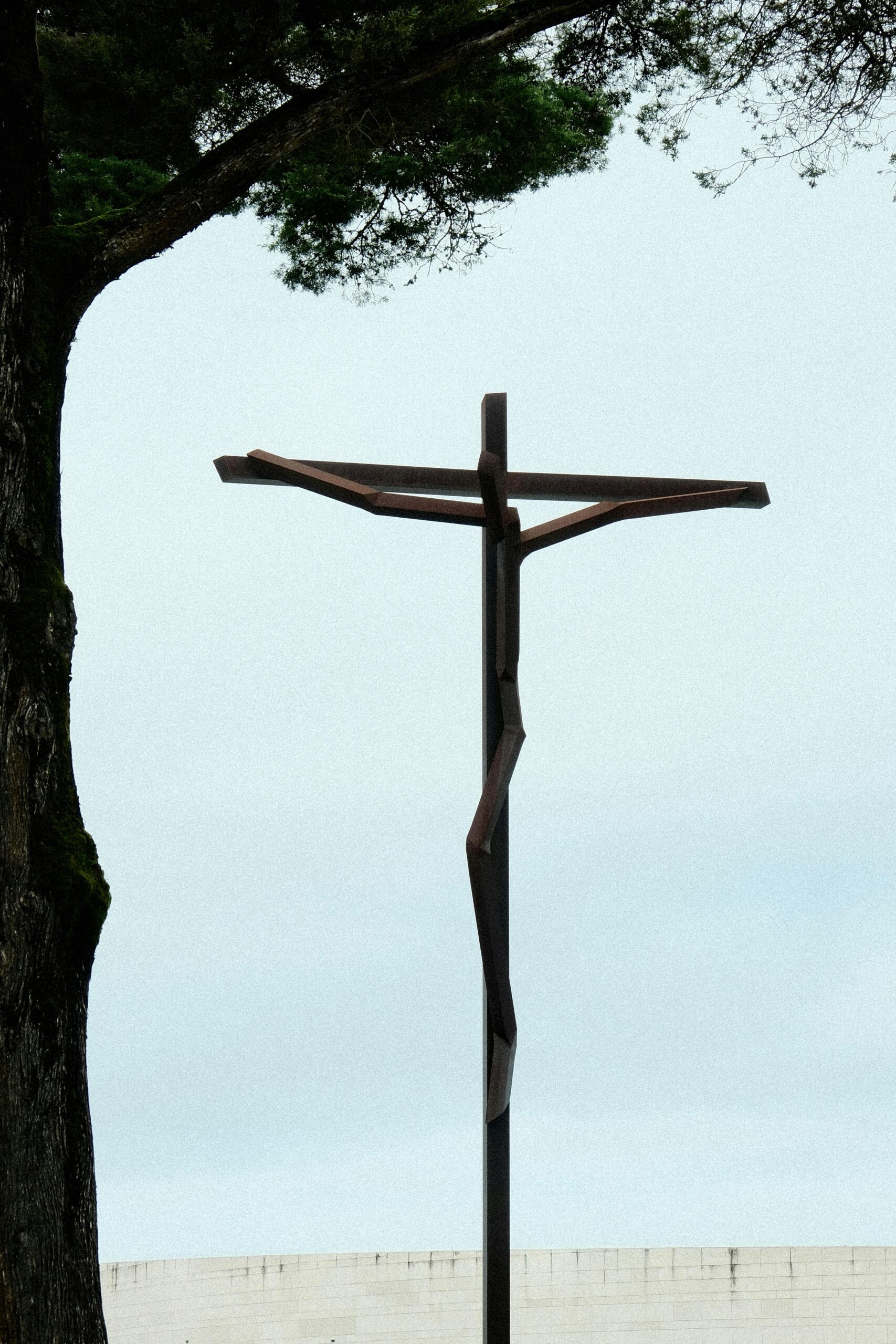
Easter 2026, Stages of the Crucifixion 9-16
Last time we introduced the story of Christ’s crucifixion and the events surrounding his burial and internment. These events can be described as a narrative that can be woven together from the four gospel accounts. I mentioned last time this is not new with me but rather a summary from Arnold Fructenbaum’s abridged work, Yeshua, the life of Messiah, from his four volume set on the life of Christ. The gospel writers describe a number of distinct events that we can tease out and examine. Last time we covered the scenes from his sentencing to the distribution of his garments. To summarize I will read the pertinent verses with some paraphrasing, fill-ins, and explanations as we go.
- Jesus bears his cross, Jn 19:16-17, Finally Pilate handed him over to them to be crucified. So the soldiers took charge of Jesus. 17 Carrying his own cross, he went out to the place of the Skull (which in Aramaic is called Golgotha).
- Simon is forced to carry the cross, Mk 15:21, A certain man from Cyrene, Simon, the father of Alexander and Rufus, was passing by on his way in from the country, and they forced him to carry the cross.
- The lament over Jerusalem, Lk 23:27-32, A large number of people followed him, including women who mourned and wailed for him. 28 Jesus turned and said to them, “Daughters of Jerusalem, do not weep for me; weep for yourselves and for your children. 29 For the time will come when you will say, ‘Blessed are the childless women, the wombs that never bore and the breasts that never nursed!’ 30 Then “‘they will say to the mountains, “Fall on us!”
and to the hills, “Cover us!”’[b] 31 For if people do these things when the tree is green, what will happen when it is dry?” - The arrival at Golgotha, Mk 15:22, They brought Jesus to the place called Golgotha (which means “the place of the skull”).
- The offering of wine and myrrh, Mt 27:34, There they offered Jesus wine to drink, mixed with gall; but after tasting it, he refused to drink it.
- The crucifixion, Mk 15:24, and they crucified him, Mk 15:25, It was nine in the morning when they crucified him.
- The first statement, Lk 23:34, Jesus said, “Father, forgive them, for they do not know what they are doing.”
- The parting of his clothes, Jn 19:23-24, When the soldiers crucified Jesus, they took his clothes, dividing them into four shares, one for each of them, with the undergarment remaining. This garment was seamless, woven in one piece from top to bottom. 24 “Let’s not tear it,” they said to one another. “Let’s decide by lot who will get it.” This happened that the scripture might be fulfilled that said, “They divided my clothes among them and cast lots for my garment.”[a] So this is what the soldiers did.
Today we pick up the story with the ninth stage, the placement of the superscription.
Stage 9, the Superscription
We next come to Jn 19:19-22, Pilate had a notice prepared and fastened to the cross. It read: Jesus of Nazareth, the king of the jews. 20 Many of the Jews read this sign, for the place where Jesus was crucified was near the city, and the sign was written in Aramaic, Latin, and Greek. 21 The chief priests of the Jews protested to Pilate, “Do not write ‘The King of the Jews,’ but that this man claimed to be king of the Jews.” 22 Pilate answered, “What I have written, I have written.”
A prisoner’s crimes were publicly posted on either a parchment or piece of wood, then affixed to the cross so those passing by would know the purpose of the crucifixion. As I noted before, this placard was placed either above the head or below the feet depending on the type of cross. With a capital T shaped cross it was placed below the feet, and with a small t type cross it was placed above the head. Mt 27:37 clearly states this placard was placed above Jesus’s head so we know he was on a small t shaped cross, as Mathew records, Above his head they placed the written charge against him: this is Jesus, the King of the Jews.
The text was written in three languages, Aramaic for the Jews, Latin for the Romans, and Greek for everyone else. The Jewish leaders (the Pharisees and Sadducees) recognized the charge was written as a title and not an accusation, therefore they petitioned Pilate to change it, which he refused, thereby enjoying a bit of revenge against the Jewish leaders who had intimidated him into doing something he didn’t want to do.
Stage 10, The Crucifixion of the Two Thieves
Mt 27:38, Two rebels were crucified with him, one on his right and one on his left.
Matthew records for us that soon after Jesus was hoisted on the cross two other criminals were also crucified. One on his right and the other on his left. Other translations have thieves rather than rebels. But rebel is a better translation as thievery was not a capital offense, but treason was. These two criminals were likely insurgents –perhaps aligned with Barabas who was released in leu of Christ. Matthew makes special mention that a criminal was crucified on either side of Jesus, thus fulfilling what Isaiah foretold in Is 53:12b which states, because he poured out his life unto death, and was numbered with the transgressors.
Stage 11, the Fifth Mockery
Jesus sustained eight mockeries during his trial and crucifixion. Four occurred during his trial and four more occurred in the first three hours of his crucifixion.
Jesus had both a religious trial composed of three parts and a civil trial composed of three parts. The religious trial initially started with Annas, then moved before Caiaphas, then finally the Sanhedrin. Jesus then had a civil trial before Rome starting with Pilate, then before Herod Antipas, and then back to Pilate again. The four mockeries during the trials are noted in the following verses,
- Lk 22:63 (following the trial before Caiaphas), The men who were guarding Jesus began mocking and beating him.
- Lk 23:11 (during the trial before Herod Antipas), Then Herod and his soldiers ridiculed and mocked him. Dressing him in an elegant robe, they sent him back to Pilate.
- Jn 19:2-3 (during the second trial before Pilate), The soldiers twisted together a crown of thorns and put it on his head. They clothed him in a purple robe 3 and went up to him again and again, saying, “Hail, king of the Jews!” And they slapped him in the face.
- Mk 15:16-19 (following the second trial before Pilate), The soldiers led Jesus away into the palace (that is, the Praetorium) and called together the whole company of soldiers. 17 They put a purple robe on him, then twisted together a crown of thorns and set it on him. 18 And they began to call out to him, “Hail, king of the Jews!” 19 Again and again they struck him on the head with a staff and spit on him. Falling on their knees, they paid homage to him. (also see Mt 27:27-30).
The other four mockeries occurred during the crucifixion. The first accounts for stage 11, and the others comprise stages 12, 13, and 14.
The fifth mockery is described in Mk 15:29-30, Those who passed by hurled insults at him, shaking their heads and saying, “So! You who are going to destroy the temple and build it in three days, 30 come down from the cross and save yourself!” (see also Mt 27:39-40).
Golgotha was near a main road that exited the NW side of the city. Since it was now Passover morning and the day of Preparation for the Sabbath (the next day) many people would be traversing in and out of the city and would pass by and see the inscription above Jesus’s head. Many knew the original charge against him and therefore taunted him regarding his claims.
Stage 12, the Sixth Mockery
Mark also describes the sixth mockery. In this case, instead of the common people, it is now the religious leaders who come to witness Jesus’s sufferings and chose to hurl insults at him while He is dying.
Mark records the scene, Mk 15:31-32a, In the same way the chief priests and the teachers of the law mocked him among themselves. “He saved others,” they said, “but he can’t save himself! 32 Let this Messiah, this king of Israel, come down now from the cross, that we may see and believe.” (see also Mt 27:4-43)
Stage 13, the Seventh Mockery
Now it is the soldiers turn as Luke records in Lk 23:36-37, The soldiers also came up and mocked him. They offered him wine vinegar 37 and said, “If you are the king of the Jews, save yourself.”
Stage 14, the Eighth Mockery
The final mockery is committed by the two men who are crucified on either side of Jesus. Matthew records their taunts in Mt 27:44, In the same way the rebels who were crucified with him also heaped insults on him. (see also Mk 15:32b). Lk 23:39 also records one of their taunts, One of the criminals who hung there hurled insults at him: “Aren’t you the Messiah? Save yourself and us!”
Note four separate groups mocked the Lord (common people, the religious leaders, the soldiers, and the two people who were being crucified with him) and all four ask him to save himself by coming down from the cross. This was Satan’s last chance to try to get Jesus off the cross. Satan wanted him to die –just not in this way -for Satan wanted to prevent the atonement that would come from Christ dying in this way.
Stage 15, the Conversion of the Rebel
After mocking Jesus, and hanging on a cross next to Jesus, Luke notes that one of the rebels reconsiders. Luke records the scene in Lk 23:39-42, One of the criminals who hung there hurled insults at him: “Aren’t you the Messiah? Save yourself and us!” 40 But the other criminal rebuked him. “Don’t you fear God,” he said, “since you are under the same sentence? 41 We are punished justly, for we are getting what our deeds deserve. But this man has done nothing wrong.” 42 Then he said, “Jesus, remember me when you come into your kingdom.[d]”
After contemplating his situation this rebel came to four conclusions,
- He concluded he was a sinner. He understood he deserved his punishment (we are punished justly) This is significant because no one can recognize their need for a savior unless they see themselves as lost and in need of one. They must see themselves as God sees them—as a sinner– and only God can show them that.
- He recognized that while he was a sinner, Jesus was not (This man has done nothing wrong).
- Even though both were dying, he believed this innocent man dying next to him could somehow help him.
- So, he makes a faithful request, He asks Jesus to remember me when you come into your kingdom. Obviously he had heard or had understood some of Jesus’s claims. So he makes a request and Jesus honors it.
Stage 16, the Second Statement from the Cross
Jesus now responds to the rebel in Lk 23:43, Jesus answered him, “Truly I tell you, today you will be with me in paradise.”
Jesus honors the rebel’s request and states this very day the rebel would be with Jesus in paradise. This implies the following,
- Jesus knew the rebel would die soon after he would.
- Jesus responds to the man’s faith and assures the rebel he will be with him.
- The rebel would join Jesus in paradise.
Here we can take a little diversion and answer the question, what is paradise? And the bigger question, where will we go after we die? This is a common but knowable question, and the best way to understand the answer is to know a few terms, to divide people as to whether they are believers or unbelievers, and to think of when they died—either before the Resurrection or after.
The Bible states we are composed of a physical body, a soul -our emotions, mind, and will, and a spirit-that which is eternal and is sensitive and responds to spiritual matters (see 1 Thess 5:23).
Before the Resurrection the Bible says that the spirits of all people who die go to a place called Sheol, (the realm of the dead), while their physical bodies return to dust. Sheol is divided into two parts; one for unbelievers (Old Testament unbelievers -OTUB) called Torments (also called hades), and the other for believers (Old Testament Believers-OTB) called Abraham’s Bosom or Paradise (see Lk 16). OTUB will remain in Torments until the Great White Throne Judgment of Rev 20 where they will be physically resurrected and judged according to their works. Following Christ’s resurrection, the spirits of OTB were escorted into heaven (Eph 4:8-10) and will receive new resurrection bodies prior to Christ’s millennial reign.
After the Resurrection, the spirits of believers go to be with the Lord in heaven (2 Cor 5), while their bodies return to dust. Their bodily resurrection will occur at the rapture (2 Cor 5 and 1 Cor 15). Unbelievers will go to torments while their bodies will return to dust. Their bodily resurrection will occur at the GWT judgement.
In the rebel’ s case, he would join Christ in Paradise, another name for Abraham’s bosom (see Lk 16), where Old Testament saints went after death.