
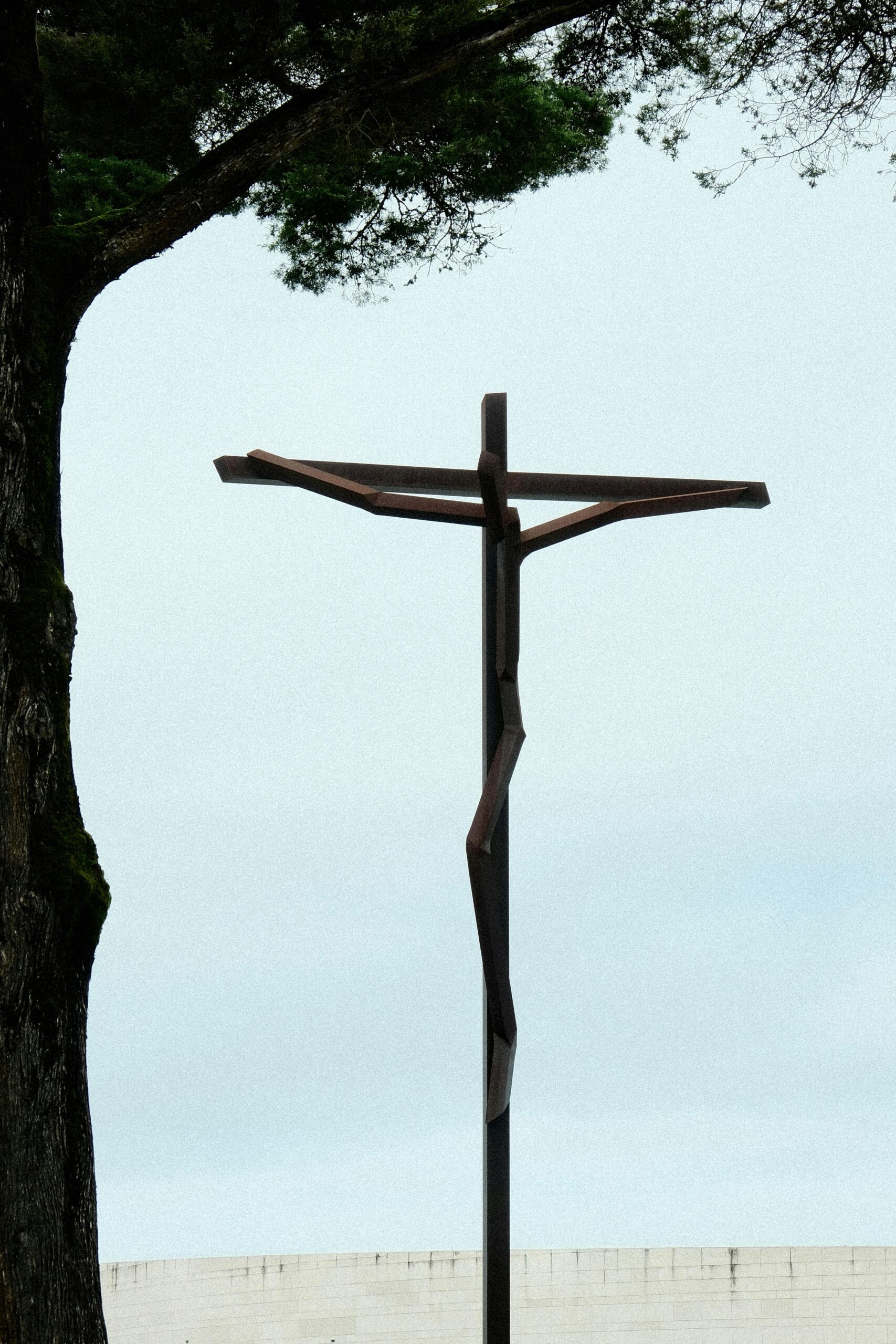
Easter 2026, Stages of the Crucifixion 1-8
1 Cor 15:3-4, tells us the gospel in a succinct form; that Christ died for our sins according to the scriptures, that he was buried, that he was raised on the third day according to the scriptures. Today we begin a study of the first two parts of this verse: Christ’s death and burial. Scripture presents four perspectives on what happened but none of the gospels are written as a chronological whole. It is therefore instructive to integrate these four narratives into one so we all have a better understanding of what historically happened. What I am about to present is not original with me. I am sharing a condensed and summarized version from Arnold Fructenbaum’s book, Yeshua, the life of Messiah, a 650 page abridged book of his four volume set on the Life of Christ.
There are many places where we could start our story: the triumphal entry, the few days between that day and Passover, the events of Passover evening, or the trial before the Sanhedrin and Pilate. But as we are focusing on his death and resurrection we will start with the events immediately following his condemnation and sentencing. This description is found in Mk 15:16-19 and Mt 27:27-31, which I shall now read, Then the governor’s soldiers took Jesus into the Praetorium and gathered the whole company of soldiers around him. 28 They stripped him and put a scarlet robe on him, 29 and then twisted together a crown of thorns and set it on his head. They put a staff in his right hand. Then they knelt in front of him and mocked him. “Hail, king of the Jews!” they said. 30 They spit on him, and took the staff and struck him on the head again and again. 31 After they had mocked him, they took off the robe and put his own clothes on him. Then they led him away to crucify him.
The hours leading up to the death of Christ and his internment in the tomb can be recounted in thirty two (32) distinct stages and we will enumerate and comment on each one.
Stage 1, Messiah bears his cross
Jn 19:16-17 tells us what happened after his sentencing. Finally Pilate handed him over to them to be crucified. So the soldiers took charge of Jesus. 17 Carrying his own cross, he went out to the place of the Skull (which in Aramaic is called Golgotha). Jesus was sentenced at the Praetorium which was the Roman garrison adjacent to the Temple (also called the Antonia Fortress). This was on the Northeastern side of the city adjacent to the Temple Mount while Golgotha, the execution site, was on the northwest side of the city. Therefore, the Roman guard would have to march Jesus across the city (about a half a mile) and then outside the city wall to the execution site. Roman law required the condemned to carry their own means of execution. In the case of crucifixion this usually meant the crossbeam rather than the pole upon it would be hoisted. Jesus had been severely flogged prior to this event (Jn 19:1, then Pilate had Jesus flogged with a lead tipped whip) so he is not able to carry this crossbeam for any distance.
Stage 2, Simon of Cyrene is forced to carry the cross
Mk 15:21, A certain man from Cyrene, Simon, the father of Alexander and Rufus, was passing by on his way in from the country, and they forced him to carry the cross. Cyrene was a district or province in North Africa. Simon was therefore a North African Jew who had come to Jerusalem to observe Passover. Jerusalem was too small a city to accommodate the many visitors during Passover season, so temporary tent cities sprang up beyond the city walls as there was no room in the city itself. On Passover evening, unless one had made arrangements inside the city, most visitors took the Passover meal in their tent outside the city wall. However on the day of Passover many would enter the city to observe the special Passover sacrifice. Simon was such an individual as Mark notes he was passing by on his way in from the country. Simon found himself on the route from the Praetorium to Golgotha and as Jesus could no longer physically carry his cross, the Roman soldiers forced Simon to carry it for him. This event must have had a profound impact on Simon as he no doubt would witness all that was to come. Curiously, Mark also notes he had two sons. Mark obviously thought this was an important detail for his readers. Mark wrote to a Roman audience and it is interesting there is a Rufus who is mentioned in Romans 16:13. Many speculate the Rufus of Mk 15:21 is the same Rufus of Rm 16:13. The Christian church in Rome was one of the few that was not formed by one of the apostles. How did it form? Most likely by converted Jews or Gentile proselytes who brought the good news back to Rome from somewhere else. It is also interesting to note that in Acts 11:20 certain believers went from Cyprus and Cyrene to Antioch and started preaching the gospel to the Gentiles. Putting these two things together it is highly probable Simon and his family came to faith that day or shortly thereafter which had a seminal impact on the formation of the church both back home in Cyrene and later in Antioch and Rome.
Stage 3, The Lament over Jerusalem
We now come to Lk 23:27, A large number of people followed him, including women who mourned and wailed for him. In first century Israel, professional wailers would often accompany any Jew taken out for execution, and that is what we find here. These were not the women who were close associates of Jesus and followed him to the cross. Rather, these were locals, the daughters of Jerusalem (vs 28) who were lamenting the execution of a Jew by Roman hands. At some point Jesus stops them and makes the statement noted in verses 28-31, Jesus turned and said to them, “Daughters of Jerusalem, do not weep for me; weep for yourselves and for your children. 29 For the time will come when you will say, ‘Blessed are the childless women, the wombs that never bore and the breasts that never nursed!’ 30 Then ‘they will say to the mountains, “Fall on us!” and to the hills, “Cover us!”’[b] Note Jesus says they are to weep for themselves and their children. This is a reference to Mt 27:25 when the people had replied back to Pilate regarding Jesus,All the people answered, “His blood is on us and on our children!” Jesus is lamenting the coming Judgement of 70 AD when Rome will come, destroy the Temple, disperse the people, and end the sacrificial system. Note Jesus ends his lament with verse 31, For if people do these things when the tree is green, what will happen when it is dry?” This is a reference to Ek 20:47 (Say to the southern forest: ‘Hear the word of the Lord.” This is what the Sovereign Lord says: I am about to set fire to you, and it will consume all your trees, both green and dry. The blazing flame will not be quenched, and every face from south to north will be scorched by it). Basically what Jesus is saying is this, If I suffer this much and I am innocent, how much more will you suffer who are guilty?
Stage 4, The Arrival at Golgotha
Jesus, with Simon carrying his crossbeam, now arrives at Golgotha. Mk 15:22 records this for us, They brought Jesus to the place called Golgotha (which means “the place of the skull”). All four gospels state Jesus was brought here. The place of the skull, did not mean it looked like a skull, rather it was the place of execution.
Stage 5, Wine mixed with Gall and Myrrh
Upon arrival to an execution site, prisoners were offered a drink to dull their upcoming pain and agony. This drink consisted of wine with alcohol and myrrh which was a bitter tasting aromatic resin often used as an anesthetic. Because it had anesthetic properties myrrh was associated with death. Hence the wise men had given Jesus myrrh as a prophetic indication of his death (Mt 2:11). Often this drink caused stupor and occasionally unconsciousness. This drink is now offered to Jesus in Mk 15:23, Then they offered him wine mixed with myrrh, but he did not take it. Mt 27:34 states the drink offered to Jesus was wine mixed with gall (There they offered Jesus wine to drink, mixed with gall). Most authorities claim gall was another term used for myrrh. Note Jesus tasted this concoction, but then refused to drink it. The reason was Jesus wanted full control of his mental faculties to do what he need to do on the cross.
Now we come to the crucifixion itself. Jesus suffered six hours upon the cross, from 9 am in the morning till 3 pm in the afternoon. His suffering can be divided into two sections; the first three hours from 9 am till noon in which he suffered the wrath of men, and then the second three hours from noon to 3 pm in which he suffered the wrath of God. The wrath of man encompasses stages 6-17, while the wrath of God are noted in stages 18-25.
THE FIRST THREE HOURS, THE WRATH OF MAN
Stage 6, the Crucifixion
Mk 15:25 notes, It was nine in the morning when they crucified him. The time of Jesus crucifixion is important. It is now Passover day. It was at 9 am when the priests offered the special Passover lamb at the Temple. So at the same time the Passover lamb is being sacrificed, Jesus the Lamb of God is being nailed to a Roman cross outside the city walls.
Crucifixion was the most brutal and agonizing form of execution in the ancient world. Initially conceived by the Assyrians, it passed to the Babylonians and Alexander the Great brought it back to Greece and Macedonia. The Romans then adopted it and used it to execute slaves, foreigners, enemies of the state, and on rare occasions its own citizens. It was often used as a terror weapon to intimidate foes into surrendering or to impress occupied lands that this is what happens to you if you rebel.
The Romans used four distinct types of crosses. One was a straight pole, another looked like the letter X, one like the capital letter T, and the last resembled a small letter t, the traditional form we think of today. So on what type of cross was Jesus crucified? Though we are not told in the gospel accounts a good case can be made for the small t type. This is because the pole and X type crosses were mainly used in the western part of the empire while the other two were more common in the east. Additionally a small plaque was placed on the cross where the charges against the accused were posted and could be read. On the capital T shaped cross this plaque was placed under the feet while in the small t type cross they were placed over the head. Matthew makes clear the charges against Jesus were written and placed above his head, so most likely Jesus was crucified on a small t type cross.
Another thing to be noted is wood was scarce. So the upright portion of the small t was most likely a semi-permanent fixture at the execution site and was reused again and again. The cross beam was more portable as it was smaller and was the part of the cross Jesus and Simon most likely carried. It too was recycled from one victim to the next.
All the gospel texts simply mention that Jesus was crucified. Recent archeological evidence has given us a better understanding of this gruesome event. We commonly think that Jesus was impaled through his hands although the Romans didn’t trust the hand alone to support the weight of the body without tearing free. In the NT the Greek word used for hand can also mean the distal forearm, so it is likely Jesus was affixed to the crossbeam with a nail through his distal wrist between the radius and ulna which would better bear the weight of the body (Some authorities claim the arms were wrapped around the crossbeam and then affixed). The legs were then affixed on either side of the vertical pole with a nail through each calcaneus (or heel bone). Usually a small wooden bar was placed under the feet to assist with breathing allowing the victim to push off against it to alleviate the weight of his hanging body against his lungs. This allowed for prolonged suffering as it delayed death. It also caused the victim’s back to rub up and down against the course cross causing more pain (remember the back of Jesus had been flogged so was open and shredded. To move against this course wood would have been excruciatingly painful).
There has been some debate as to whether the vertical pole was always fixed in the ground, which meant the prisoner with the crossbeam, must be hoisted and then the crossbeam affixed, or could it be removed then lain flat so the prisoner could be stretched out and affixed to both crossbeam and pole then lifted upright as a unit. Recent evidence suggests this later method was the one used. In either case, once settled in the ground, the pole with crossbeam extended nine to twelve feet above the ground. Some have also argued that since this hoisting placed enormous stress on the wrists, shoulders, and ankles, it would occasionally sub lux or dislocate the joint. The psalmist speaks prophetically of this torture in Ps 22:14, I am poured out like water, and all my bones are out of joint. My heart has turned to wax; it has melted within me. My mouth[d] is dried up like a potsherd, and my tongue sticks to the roof of my mouth; you lay me in the dust of death.
Depending on the underlying condition of the prisoner, death would usually come within several hours, or up to 3 days and was the result of a combination of dehydration, blood loss (if previously flogged), and asphyxiation (especially if the prisoner had their legs broken as they could no longer support themselves to breathe).
In Deut 21:22-23 there was a special curse for those who were executed and then hung on a tree, If someone guilty of a capital offense is put to death and their body is exposed on a pole, 23 you must not leave the body hanging on the pole overnight. Be sure to bury it that same day because anyone who is hung on a pole is under God’s curse. Note the law states their body must be removed by sundown. This law will become important towards the end of our story when Joseph of Arimathea requests the body from Pilate.
Stage 7, the First Statement
Jesus made seven statements from the cross and the first is recorded in Lk 23:34, Jesus said, “Father, forgive them, for they do not know what they are doing.” This was a plea for the forgiveness of those who acted in ignorance for killing him; Most likely the soldiers who were now conducting his execution.
Stage 8, the Parting of the Garments
Jn 19:23-24 records what happened next, When the soldiers crucified Jesus, they took his clothes, dividing them into four shares, one for each of them, with the undergarment remaining. This garment was seamless, woven in one piece from top to bottom. 24 “Let’s not tear it,” they said to one another. “Let’s decide by lot who will get it.” This happened that the scripture might be fulfilled that said, “They divided my clothes among them and cast lots for my garment.”[a] So this is what the soldiers did.
Traditionally four Roman soldiers would be assigned to each crucifixion and as part of their compensation they were entitled to the clothes of the victim. Typically a Jewish male would wear five pieces of clothing,
- The under garment (also called the inner garment or tunic—think a long T shirt that covered the chest, abdomen, pelvic region and extended to mid or lower thigh.
- The outer garment (think a heavier kimono like garment that could extend to just above the ankle).
- Some kind of head covering.
- Shoes or sandals.
- A robe or outer coat, which was the largest single piece of cloth—used for cooler weather.
The inner tunic, outer garment, head covering, and sandals were distributed among the four soldiers by lot or collective agreement. Often times the robe was also torn and each soldier took a quarter of it. However if the coat were expensive it was often distributed by lot. This is what happened in Jesus’s case. Though poor, we know Jesus had some wealthy patrons (see Lk 8:3) and someone had given Jesus an expensive coat.
John records what Ps 22:18 had predicted, they divide my clothes among them and cast lots for my garment. Contrary to popular notions, Jesus had no loin cloth at his crucifixion. Victims were entirely naked to increase their shame.