
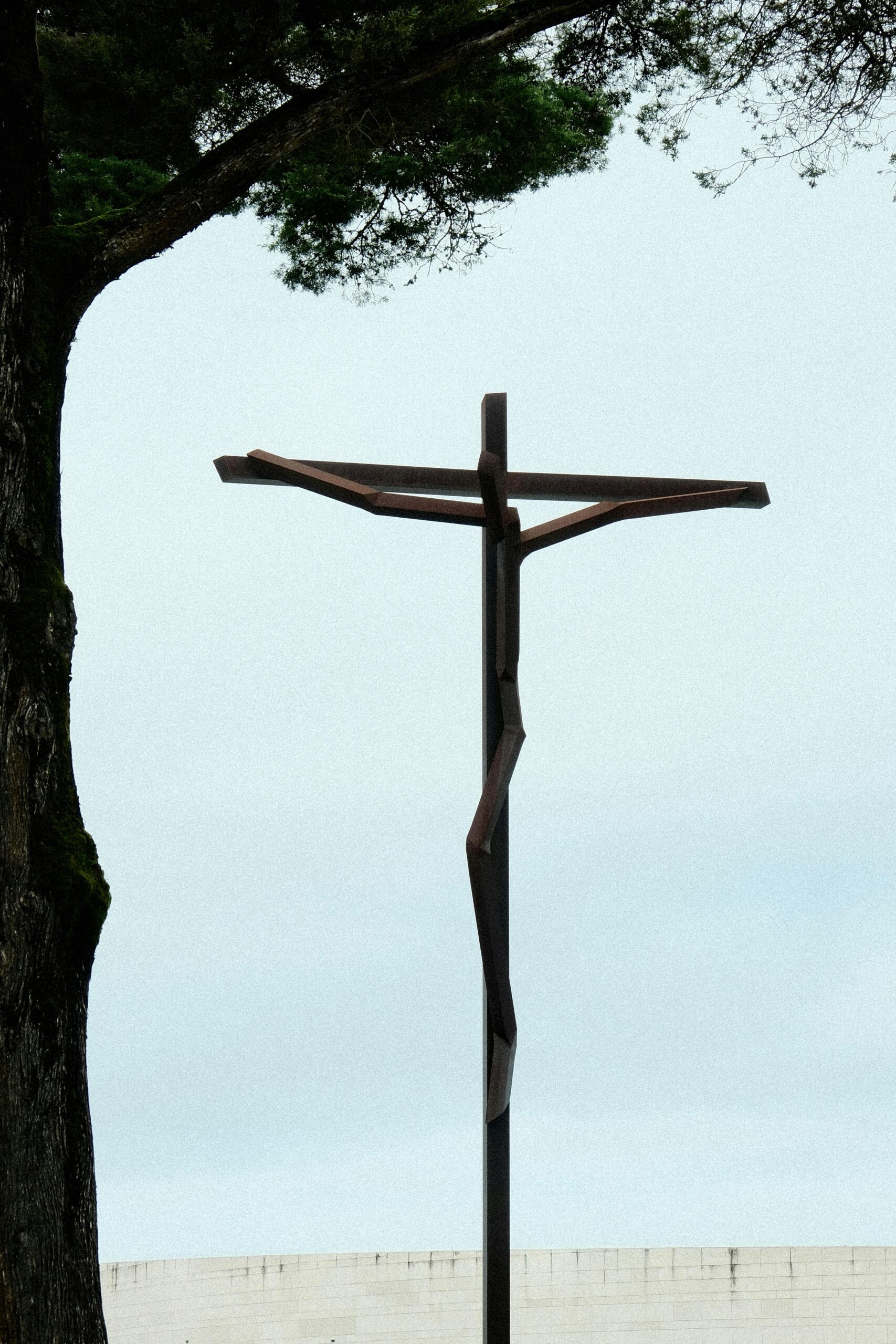
Easter 2026, Stages of the Crucifixion Stages 27-32
We have been studying the various stages of the crucifixion. Last time we began with Jesus transferring the care of his mother Mary to his disciple John. We then looked at the second three hours on the cross where Jesus suffered the wrath of God. To summarize,
- Stage 17, The transfer of care, Jn 19:25-27, Near the cross of Jesus stood his mother, his mother’s sister, Mary the wife of Clopas, and Mary Magdalene. 26 When Jesus saw his mother there, and the disciple whom he loved standing nearby, he said to her, “Woman,[b] here is your son,” 27 and to the disciple, “Here is your mother.” From that time on, this disciple took her into his home.
- Stage 18, the Darkness over the Land, Lk 23:44-45, It was now about noon, and darkness came over the whole land until three in the afternoon, 45 for the sun stopped shining.
- Stage 19, the Fourth Statement, Mt 27:46, About three in the afternoon Jesus cried out in a loud voice, “Eli, Eli,[c] lema sabachthani?” (which means “My God, my God, why have you forsaken me?”).
- Stage 20, the Reaction of the Bystanders, Mt 27:47-49, When some of those standing there heard this, they said, “He’s calling Elijah.” 48 Immediately one of them ran and got a sponge. He filled it with wine vinegar, put it on a staff, and offered it to Jesus to drink. 49 The rest said, “Now leave him alone. Let’s see if Elijah comes to save him.
- Stage 21, the Fifth Statement, Jn 19:28, Later, knowing that everything had now been finished, and so that Scripture would be fulfilled, Jesus said, “I am thirsty.”
- Stage 22, the Drinking of the Vinegar, Jn 19:29, A jar of wine vinegar was there, so they soaked a sponge in it, put the sponge on a stalk of the hyssop plant, and lifted it to Jesus’ lips.
- Stage 23, the Sixth Statement, Jn 19:30a, When he had received the drink, Jesus said, “It is finished.”
- Stage 24, the Seventh Statement, Lk 23:46a, Jesus called out with a loud voice, “Father, into your hands I commit my spirit.”[e]
- Stage 25, the death of Jesus, Lk 23:46b, When he had said this, he breathed his last.
- Stage 26. The Accompanying Signs, Mt 27:51, At that moment the curtain of the temple was torn in two from top to bottom. The earth shook, the rocks split 52 and the tombs broke open. The bodies of many holy people who had died were raised to life. 53 They came out of the tombs after Jesus’ resurrection and[e] went into the holy city and appeared to many people.
Stages 27 through 32 mark the events of Jesus’s burial. These things are discussed in Mt 27:57-60, Mk 15:42-46, Lk 23:50-54, and Jn 19:31-42.
Stage 27, The breaking of the Rebel’s bones and the piercing of Christ’s body
John records the scene for us in Jn 19:31-34, Now it was the day of Preparation, and the next day was to be a special Sabbath. Because the Jewish leaders did not want the bodies left on the crosses during the Sabbath, they asked Pilate to have the legs broken and the bodies taken down. 32 The soldiers therefore came and broke the legs of the first man who had been crucified with Jesus, and then those of the other. 33 But when they came to Jesus and found that he was already dead, they did not break his legs. 34 Instead, one of the soldiers pierced Jesus’ side with a spear, bringing a sudden flow of blood and water.
It is now Passover day and since Passover day fell on a Friday the year Christ was crucified it is also the day of Preparation for the Sabbath which is the next day. The occurrence of the Passover the day before the Sabbath was unusual and so the Sabbath after such an event was called a High Sabbath. This is why John notes it was special. The day of preparation simply meant that you had to do everything you needed to do on the Friday so you didn’t have to do any work on Saturday. So in anticipation of the High Sabbath the Jewish leaders petition Pilate to speed the deaths of the crucified and so the soldiers break the legs of the two rebels (so they couldn’t push off the wooded bar under their feet-see stage 6). When the soldiers come to break Jesus’s legs they see he has already died.
In celebration of the Passover the Israelites were told in Ex 12:46 that the Passover lamb was to be eaten inside the house, take none of the meat outside the house. Do not break any of the bones. Ps 34:20 in speaking of the Messiah, states he protects all his bones, not one of them will be broken. I Cor 5:7 states Jesus is our Passover lamb, and so the soldiers fulfill what the scriptures predicted –none of Jesus’s bones would be broken.
John then notes the soldier pierces Jesus with his spear and a mixture of blood and water came forth. The piercing of Jesus and the spilling of water and blood has been a subject of intense theological discussion for the past 2000 years. It is best understood when examined from three different perspectives; physically, prophetically, and symbolically.
Physically
John states the soldiers pierced Christ and out came a mixture of blood and water. How are we to physically explain this? Many have postulated various explanations. Perhaps the most plausible is the idea that the water was serum which had separated out accompanied by blood, or perhaps it was pleural fluid along with blood as a result of the traumatic beatings prior to his crucifixion.
Prophetically
We can also look at the spearing prophetically. Is 53:5 states he was pierced for our transgressions. This was not a random or accidental act. Though the soldiers had no idea what Isaiah had said about the Messiah 800 years before, they were fulfilling God’s providential plan that testified to the Messiah’s identity.
Zechariah also prophesied regarding this event and notes that at some point in the future, rather than rejecting their Messiah, Israel will mourn over him and accept him, Zech 12:10, And I will pour out on the house of David and the inhabitants of Jerusalem a spirit[a] of grace and supplication. They will look on[b] me, the one they have pierced, and they will mourn for him as one mourns for an only child, and grieve bitterly for him as one grieves for a firstborn son.
Symbolically
Symbolically, Blood in Scripture represents life and atonement (the following from bibleask.org). In the Old Testament, God commanded sacrifices as a means to atone for sin,Lev 17:11, For the life of a creature is in the blood, and I have given it to you to make atonement for yourselves on the altar; it is the blood that makes atonement for one’s life.
Jesus’ blood fulfills the entire sacrificial system as noted in Heb 9:12, He did not enter by means of the blood of goats and calves; but he entered the Most Holy Place once for all by his own blood, thus obtaining[b] eternal redemption and 1 Jn 1:7, But if we walk in the light, as he is in the light, we have fellowship with one another, and the blood of Jesus, his Son, purifies us from all[b] sin.
When blood flowed from Jesus’ side, it represented the price of our redemption—the ultimate sacrifice that brings forgiveness of sins.
Water, in scripture represents cleansing and spiritual renewal. The priests were to bathe before sacrifice, Ex 30:18-21, Make a bronze basin, with its bronze stand, for washing. Place it between the tent of meeting and the altar, and put water in it. 19 Aaron and his sons are to wash their hands and feet with water from it. 20 Whenever they enter the tent of meeting, they shall wash with water so that they will not die. Also, when they approach the altar to minister by presenting a food offering to the Lord, 21 they shall wash their hands and feet so that they will not die.
Aaron was to bathe before the sacrifice of the Day of Atonement, Lev 16:4, He is to put on the sacred linen tunic, with linen undergarments next to his body; he is to tie the linen sash around him and put on the linen turban. These are sacred garments; so he must bathe himself with water before he puts them on.
Ezekiel spoke of God cleansing the nation, Ez 36:25,I will sprinkle clean water on you, and you will be clean; I will cleanse you from all your impurities and from all your idols.
In the NT water speaks of the Holy Spirit and spiritual renewal.
Jn 3:5, Jesus answered, “Very truly I tell you, no one can enter the kingdom of God unless they are born of water and the Spirit.
Jn 7:37-39, On the last and greatest day of the festival, Jesus stood and said in a loud voice, “Let anyone who is thirsty come to me and drink. 38 Whoever believes in me, as Scripture has said, rivers of living water will flow from within them.”[c] 39 By this he meant the Spirit, whom those who believed in him were later to receive. Up to that time the Spirit had not been given since Jesus had not yet been glorified.
John was in many ways the most theological of the gospel writers. By including both blood and water, God through John’s writing gives a terse but richly symbolic picture: With the death of Christ, the blood brings forgiveness, and the water brings cleansing and new life.
Stage 28, the Request for the Body
Jesus is now dead and Joseph of Arimathea goes to Pilate to request the body. All four Gospel writers record Joseph’s request. I will read Matthew’s account from Mt 27:57-58, As evening approached, there came a rich man from Arimathea, named Joseph, who had himself become a disciple of Jesus. 58 Going to Pilate, he asked for Jesus’ body, and Pilate ordered that it be given to him.
Jospeh was a godly man of which eight things are said of him in the scriptures,
- Mk 15:43, he was prominent, Hehad a good reputation, and was well known.
- Mk 15:43, he was a member of the Council (the Sanhedrin).
- Mt 27:57, there came a rich man from Arimathea, he was materially wealthy.
- Lk 23:50, Now there was a member of the Council, a good man. The word, good, emphasizes his external conformity to the Law.
- Lk 23:50, he was an upright (righteous) man, the word upright emphasizes his internal conformity to the Law.
- Mk 15:43, Lk 23:51, He was looking for the Kingdom of God. This simply means he was looking for the Messiah and the coming Messianic Kingdom.
- Lk 23:51, who had not consented to their decision and action. Joseph either did not attend Jesus’s trial before Caiaphas in protest (as the time and trial were illegal), or he did attend and opposed the actions of his fellow members.
- Jn 19:38, Joseph and Nicodemus were secret believers for fear of the Jews. Now, on the afternoon of Christ’s death, they both publicly go to Pilate and ask for the body.
(as a side note it is interesting to trace the progression of Nicodemus’ faith. In Jn 3:2 Nicodemus comes to Jesus at night, presumably in secret so no one would know he was meeting with him. In Jn 7:50-51, he defends Jesus before the Sanhedrin and now in Jn 19:38 he publicly pronounces his faith by asking Pilate for the body).
There are two main thoughts as to where Arimathea was. Some have argued it was a small town 20 miles NW of Jerusalem while others link it to Ramah, where Samuel was from.
Mark 15:44-45 notes that Pilate was surprised to hear that he was already dead. Summoning the centurion, he asked him if Jesus had already died. 45 When he learned from the centurion that it was so, he gave the body to Joseph.
Stage 29, the Removal of the Body
How the body was mechanically removed is not told. Did the soldiers remove it? Did Joseph and Nicodemus take it down? But once permission was granted, Jospeh and Nicodemus take charge of the body. Jn 19:38, simply tells us he (Joseph)came and took the body away (see also Mt 27:59, Mk 15:46, Lk 23:53).
Stage 30, The Burial of Jesus
Once Joseph and Nicodemus removed the body they were under some pressure to get it ready for burial as there was little time left before the Sabbath began (the Sabbath began at sundown –in Spring of early April roughly 6:50 pm). The Jewish custom for burial involved the following steps,
- First the body was washed.
- The body was then anointed with spice to help cover the odor of disintegration.
- The body was then wrapped.
- The face was covered with a single piece of cloth while the hands and feet were covered with strips of linen.
- The body was then lain in a tomb (depending on a family’s resources) usually on a stone bench. This was done with some haste (on the same day of death) as the climate was warm, and disintegration occurred quickly (see Jn 11:39).
- Over the course of a year or two the body would desiccate and disintegrate. After some time the tomb would be opened and the bones placed in an ossuary.
John tells us in Jn 19:40, Jesus was buried, in accordance with Jewish burial customs. So we can assume he was treated as above with a few notable comments.
- We are not told specifically in the biblical accounts if Jesus was washed. Certainly he would have needed it. John tells us in Jn 19:40 that the burial was according to custom, so can we assume he was. The question is when? As time was short to get him in the tomb before the onset of the Sabbath, some have supposed that Joseph and Nicodemus skipped this part and simply wrapped Jesus with strips of linen. As there is no mention of washing in any of the Gospel accounts this is a reasonable assumption. Lk 23:55 notes, The women who had come with Jesus from Galilee followed Joseph and saw the tomb and how his body was laid in it. 56 Then they went home and prepared spices and perfumes. But they rested on the Sabbath in obedience to the commandment. (see also Mk 15:47, Mt 27:61). So here is the thought. Joseph knew, Nicodemus knew, and the women knew more work had to be done to properly care for Jesus’s body. So the plan is for the women to see where Jesus is laid, then wait out the Sabbath with the plan to return and properly finish the job. If his body had been properly prepared, there would have been no need to return with more spices and perfumes.
- Nicodemus had brought an enormous amount of spices for the burial, Nicodemus brought a mixture of myrrh and aloes, about seventy-five pounds (Jn 19:39). This was unusual for this amount of material was reserved for a King or person of extremely high honor. This was Nicodemus’s parting gift. For these were expensive items and were a display of the reverence Nicodemus had for Jesus.
- All the gospel accts tell us Joseph and Nicodemus then wrapped Jesus’s body in strips of linen (see Mt 27:59, Mk 15:46, Lk 23:53, and Jn 19:40).
- Matthew tells us Joseph had recently built a new tomb, and this is where he laid the body. As Nicodemus provided the burial spices, now Joseph provides a new tomb in a garden, Mt 27:60, Joseph took the body, wrapped it in a clean linen cloth, 60 and placed it in his own new tomb that he had cut out of the rock. Jn 19:40 notes the tomb was also close to the execution site, At the place where Jesus was crucified, there was a garden, and in the garden a new tomb, in which no one had ever been laid. 42 Because it was the Jewish day of Preparation and since the tomb was nearby, they laid Jesus there. Whether Joseph or Nicodemus knew it, by burying Jesus in Joseph’s tomb, the prophecy of Isaiah 53:9 was fulfilled, He was assigned a grave with the wicked, and with the rich in his death, though he had done no violence, nor was any deceit in his mouth.
Stage 31, The Women Prepare to Bury Jesus
Lk 23:55-56, The women who had come with Jesus from Galilee followed Joseph and saw the tomb and how his body was laid in it. 56 Then they went home and prepared spices and perfumes. But they rested on the Sabbath in obedience to the commandment. As I mentioned above, Luke makes special mention that some of the women who witnessed Jesus’s execution, observe the work of Joseph and Nicodemus. It is now the Sabbath, and they are prevented by law to assist, so plan to return with additional spices to wash and prepare the body according to Jewish custom.
Stage 32, the Sealing of the Tomb
Only Matthew records this event. The day after the execution is the Sabbath. The religious elite –the chief priests, this would be Annas and Caiaphas, and the Pharisees are now concerned. They remember that Jesus had predicted his crucifixion (see Mt 16:21-23, Mt 17:22-23, Mt 20:17-19, Mt 26:1-2, Mk 10:33-34, Lk 9:22) and are now worried that he had also prophesied his resurrection. So they go to Pilate to request the tomb be sealed and guarded. Note the Sadducees are not mentioned as they did not believe in resurrection. Mt 27:62-64 records the scene, The next day, the one after Preparation Day, the chief priests and the Pharisees went to Pilate. 63 “Sir,” they said, “we remember that while he was still alive that deceiver said, ‘After three days I will rise again.’ 64 So give the order for the tomb to be made secure until the third day. Otherwise, his disciples may come and steal the body and tell the people that he has been raised from the dead. This last deception will be worse than the first.”
Notice they call Jesus the deceiver. This was an old Rabbinic custom for if the Rabbis had an issue with someone they would substitute an epithet or derogatory term for that person when mentioned, hence Jesus is now referred to as the deceiver.
Upon the Rabbis request, Pilate does two things; These are noted in Mt 27:65-66, Take a guard,” Pilate answered. “Go, make the tomb as secure as you know how.” 66 So they went and made the tomb secure by putting a seal on the stone and posting the guard.
First, note Pilate releases to them a Roman guard. There has been much speculation as to how many soldiers this meant. But understanding how the Jewish leaders and Rome viewed security can give us some idea. When Judas came for Jesus at Gethsemane, Jn 18:3 states there was a detachment of soldiers, while Mark called them a crowd (Mk 14:43) and Luke said they were a crowd of temple guards and officials (see Lk 22:47 and 52). It would have been unusual for this crowd to include Roman soldiers for Jesus was not yet an enemy of Rome, but it does imply an overwhelming force came for Jesus and the eleven remaining disciples. In Acts 12:4 Peter was arrested in the temple and four squads of four soldiers each were assigned to him. Indeed they may have each taken a rotation to protect him—but that is a four to one ratio. In Acts 23:13 we learn that 40 men had plotted to kill Paul. The Roman commander put together a contingent of 200 infantry, 200 spearman, and 70 calvary to escort Paul to Caesarea. So 470 men to meet a perceived threat of 40.
The general rule was to dispatch enough soldiers to meet the threat. In Jesus’s case the priests and Pharisees knew of his eleven disciples, but Jerusalem was full of Christ admirers, so what was the perceived threat? It was high. So Pilate releases a Roman guard. This was at a minimum a contingent of 16, four for each shift, but was probably much larger as Rome was all about intimidation by show of force.
The second thing Pilate does is to order his troops to secure the tomb. Wealthy people’s tombs in Biblical times consisted of either a room hallowed out in the side of a rock wall or a free standing rock room with a single door opening. A groove was placed in the ground in front of the opening and a large stone wheel was then placed in the groove to function as a door. It could then be rolled to either open or close the structure. To seal a tomb was done by pounding hooks into the wall of the tomb on the upper area on either side of the door. A single hook was then placed in the middle of the rolling stone that made the door. Ropes were then looped through the hooks and then crossed each other in the central hook on the door creating an X shape. They were secured to the ground by a stake. A clay seal was then placed over the X cross on the middle of the wheel door and directly above at the top of wheel where it touched the stone wall of the tomb. Each clay seal was stamped with a Roman insignia making it impossible to roll away the stone without breaking the seal.
Some have argued that Jesus’ s body could have been stolen away the night of his death, but it is highly unlikely a Roman guard would seal an uninspected tomb. They knew what they were guarding and they had enough force deployed to foil any attempted theft of the body.
We have now set the stage for the Resurrection (which we will study at some future date) which I will conclude with from Mt 28:1-7, After the Sabbath, at dawn on the first day of the week, Mary Magdalene and the other Mary went to look at the tomb.
2 There was a violent earthquake, for an angel of the Lord came down from heaven and, going to the tomb, rolled back the stone and sat on it. 3 His appearance was like lightning, and his clothes were white as snow. 4 The guards were so afraid of him that they shook and became like dead men.
5 The angel said to the women, “Do not be afraid, for I know that you are looking for Jesus, who was crucified. 6 He is not here; he has risen, just as he said. Come and see the place where he lay. 7 Then go quickly and tell his disciples: ‘He has risen from the dead and is going ahead of you into Galilee. There you will see him.’ Now I have told you.”