
Please turn with me to Lk 2:8-20. Here in Luke chapter 2, we have the record of our Lord’s birth, and this Christmas season I want to look at it through the eyes of those who were there. Last year, we noted the story of Simeon and his interactions with Mary and Josph when Jesus was just 8 days old. Today we are going to see the announcement of Christ’s birth to the shepherds and their reaction.
Lk 1 records the angelic visit first to the barren couple of Zechariah and Elizbeth announcing they would have a son who would be the forbearer of the Messiah, and then the angel appears to Mary, a young women in her teens or perhaps 20, whom God chose to be the mother of Jesus. She becomes pregnant by the power of the Holy Spirit. Mt 1 gives us more detail regarding her situation. Matthew tells us she was already betrothed to Joseph, who scripture says was a good man (or righteous man—which meant he was faithful to the law). He was also compassionate, because when he found she was pregnant, he meant to divorce her quietly, when he could have had her stoned. But while he wa pondering these things, an angel appeared to him and commanded him to take Mary as his wife, to name the baby Jesus, and to abstain from intimate relations with her until the boy was born.
Lk 2:1-7 records the birth of Jesus as Joseph and Mary go from Nazareth, in Galilee, to Bethlehem (which means the house of bread), which is just 6 miles south of Jerusalem. Seven hundred years before, the prophet Micah had prophesized of Bethlehem, But you, O Bethlehem Ephrathah, are only a small village among all the people of Judah. Yet a ruler of Israel, whose origins are in the distant past, will come from you on my behalf (Mic 5:2). Bethlehem was the hometown of David, who had become the King of Israel, and Micah predicts another ruler of Israel will come from this small village.
The occasion of this trip was the Roman census, and since both Joseph and Mary were descendants of David, they were to be counted in the town of their ancestors. This was about a 90 mile trip and I think we can assume there was some urgency to it for Joseph left Nazareth for Bethlehem in the late stages of Mary’s pregnancy. Bethlehem lies almost due south and just a bit east of Nazareth. Both towns are nestled in the steep hills that form a spine that runs north and south in the midsection of the country. Therefore, the journey was not an easy one.
Bethlehem was small. Archeological estimates put the village at between 300 to 1000 residents. It was a sheep town for most of its residents were shepherds who supplied lambs for the temple sacrifice in Jerusalem only a few miles away. Because of the census, there was a greater Roman presence than usual, and no doubt they had taken the choicest hotel rooms available, and with the influx of people, demand for accommodations was great.
Inns in the ancient world consisted of a four walled structure enclosing a courtyard. Usually, for security, there was only one entrance and a central source of water (being either a well or cistern). Along the walls were chambers, often with a loft so people could sleep above their livestock or donkey. The courtyard was communal and could accommodate larger animals such as camels, horses, donkeys, etc. There was often a place for food preparation and storage, to accommodate travelers’ appetites.
Upon arrival in Bethlehem, Joseph soon found out there was no room at the hotel. There were also a number of limestone caves in and around the village in which either people lived, sheltered livestock, or did both. Since the inn was full it is possible Joseph and Mary sought refuge in one of these caves, or in another structure somewhere in the town; perhaps an add on shed, or a free standing shelter for animals. Whatever Joseph found we do not know how he secured it, or who told Joseph about it, or what he paid for it. Wood was scarce so the manger was most likely a stone trough covered with straw. As noted it could have been in one of these caves or in some other form of shelter. So, the King of Kings, the creator of the universe, the Godman who would fulfill the Davidic and New Covenants, Jesus, the Christ, was born in an obscure small town, perhaps in a stone cave, and laid in a stone manger. We have no record if anyone else was there. Mary and Joseph are presumably alone; no parents, no friends, no labor coach, no nurses, no midwife, no doctor; maybe their donkey if they had one, and any other livestock that may have been in the cave. I personally fell this was the case, because as we will read, no human announces Christ’s birth. It is for God to announce the birth of his Son and He does so in the next few verses. We can divide them as follows, in verse 8-14 we have the announcement, and in verses 15-20 we have the shepherd’s response.
The Angelic Announcement, vs 8-14.
Vs 8a, That night there were shepherds
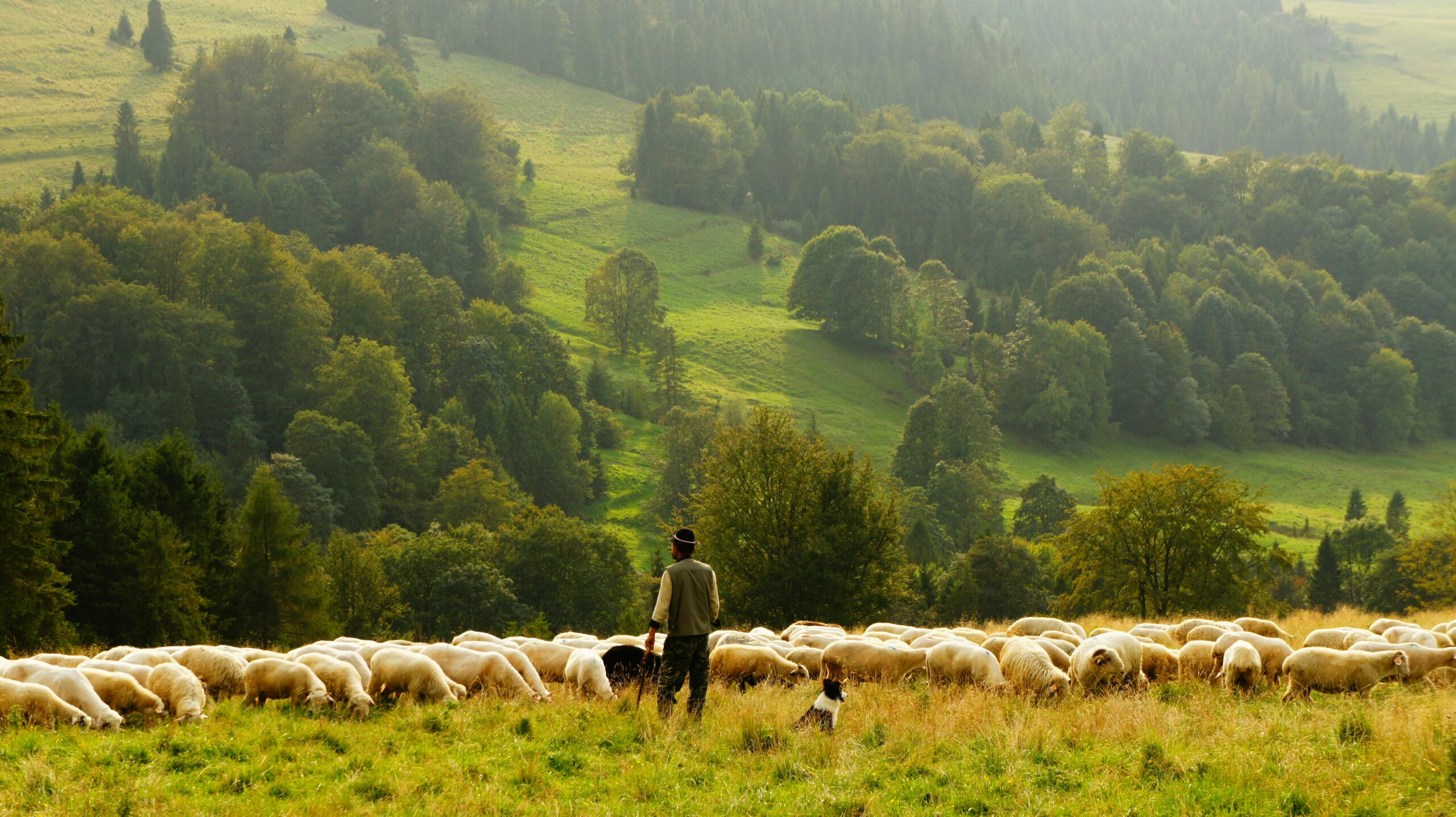
As I mentioned, Bethlehem was a sheep town; it’s primary business was raising sheep for the temple sacrifice, so in the fields surrounding the small hamlet were shepherds guarding their flocks. We do not know much about these men as scripture does not give us many details. But we know this: shepherds were a lowly lot; poor, dirty, isolated, ignorant, and uneducated, unskilled-for a child could lead sheep, therefore humble in possessions and position. Not that this was an illegitimate profession. For Abraham was a shepherd, as was Moses for part of his life. And a thousand years before, King David himself may have been in the same fields as these shepherds.
Here is another thing: by virtue of taking care of sheep seven days a week, shepherds lived in some violation of the Mosaic law. They could not keep all the requirements of the myriad regulations that Israel’s religious leaders had added to the Law. So not only were they viewed to be low on the social scale, but they were also viewed as violating the Mosaic Law, hence were seen as outcasts and sinners.
In Lk 1:48-52, Mary announces, For he took notice of his lowly servant girl, and from now on all generations will call me blessed. 49 For the Mighty One is holy, and he has done great things for me. 50 He shows mercy from generation to generation to all who fear him. 51 His mighty arm has done tremendous things! He has scattered the proud and haughty ones. 52 He has brought down princes from their thrones and exalted the humble. And certainly, like Mary, the shepherds were a lowly and humble lot.
If we step back from this story for a moment and think of how we would announce the birth of God’s Son, I do not think any of us would choose the method God lays out here. We would pick influencers on social media, leaders within our community and churches, prominent athletes and entertainers who are well known. In other words, we would contact important people, popular people, and known people. Yet, God does the opposite. He chooses this lowly group, this humble group, this unknown group, this group of lowly outcasts, this group of ignorant and cast aside people, and decides, these should be the ones to first hear the news of my Son’s birth.
And the more we think about it, this was the most appropriate way since God came to save the outcasts and sinners of the world. Jesus said in Mk 2:17, it is not the healthy who need a doctor, but the sick. I have not come to call the righteous, but sinners. And so, the first to know of the Savior’s birth were a group of shepherds out in the fields on the periphery of Bethlehem.
Vs 8b, staying in the fields nearby,
The verse notes they were staying in the fields nearby. The geography of Israel is as follows: There is a coastal plain, a range of low lying sloped lands that then give way to steep hills rising to almost 4000 ft before they then dive into the Jordan Valley 700 feet below sea level. Jerusalem and Bethlehem are situated on the spine of these steep hills. Winter is from December to March. It is cold and can occasionally snow. Those hills are exposed and open, therefore shepherds only spent the nights out in the fields between April and November, for it was too cold to do so in winter. Scripture does not tell us what month Jesus was born, nor do we know the year (although many believe it was 4 BC). But we have a clue that it was not Dec-Mar since that would put Christ’s birth in the middle of winter and the shepherds would not be out.
Vs 8c, guarding their flocks of sheep.
In ancient times, in the evening, shepherds would gather their flocks into a small pen usually constructed of stone as wood was scarce. There would be only one small opening and here the shepherd would lie across it to prevent any from leaving and so that he could survey the whole pen and keep tabs on all the animals. Jesus uses this image to describe himself in Jn 10. I am the door, He says. Literally, I am the one lying across the door of my sheep pen and none can get out. This is the doctrine of eternal security. Once you are in God’s fold, He will never let you be taken out.
So, this is the scene: Mary has given birth to a child, most likely in a cave; she has no attendants other than her husband and some animals. She uses a stone trough as a crib. She and her husband are very much alone. It is sometime between April and Nov. Shepherds have their flocks in the surrounding fields. It is night, so the shepherds have gathered their sheep into pens to watch them over the night. Then God decides to let them know His son was born. Verse 9 tells us how God made the news known.
Vs 9a, Suddenly,
like a flash of lightening on a clear night, or a clap of thunder when one is asleep.
Vs 9b, an angel of the Lord appeared among them,
In Lk 1, the angel Gabriel appeared to Zechariah, and again to Mary. Now an angel appears to the shepherds. Was this angel Gabriel as well? Many assume so, but we are not told. It is also interesting to speculate as to whether these shepherds were clustered. In other words, were their pens close together so they and their sheep were grouped allowing them all to see the angel at the same time. Or were they spread out, and each saw the angel though geographically separated from each other. We do not know.
Vs 9c, and the radiance of the Lord’s glory surrounded them.
We are told by the book of Hebrews we are to be hospitable to all for sometimes we host angels unaware. Here, the angel appears, not in the form of a man, but rather in full heavenly splendor. The full manifestation of God’s presence surrounds and emanates from this being. God flashes His glory in the fields. Scripture tells us God’s glory was last seen in Israel almost 600 years earlier when Ezekiel described it leaving the temple (Ez 8) due to Judah’s sin. And it has now returned to announce the birth of God’s son.
Vs 9d, They were terrified.
Their response is understandable. They are terrified. In Lk 1, the angel Gabriel appeared to Zechariah and to Mary. Now an angel appears to the shepherds. The sequence of each manifestation is the same: there is an appearance, then fear, then comfort, then a message, and then a sign. In vs 9b and 9d we have the appearance and fear.
Vs 10a, but the angel reassured them. “Don’t be afraid!” he said.
The angel now reassures and comforts the shepherds, and says, don’t be afraid. This phrase first appears in Gen 15:1 when God appears to Abraham. It last appears in Rev 1:17. If you trace it through, God’s accompanying message is always one of grace and mercy; and so, it is here. the message is noted in vs 10b and 11.
Vs 10b and 11, “I bring you good news that will bring great joy to all people. 11 The Savior—yes, the Messiah, the Lord—has been born today in Bethlehem, the city of David!
I am old enough now to have seen some impressive headlines throughout the years. The assassination of JFK, MLK, and RFK. The fall of Saigon, The Columbia disaster, the fall of the Berlin Wall, The invasion and liberation of Kuwait. The twin towers. The invasion of Iraq. We all have events etched in our memories over the years. But here is the greatest message the world has ever heard. The greatest news ever delivered. That God becomes man, and is now born, to be the Savior of the world. To save us from the wrath of God which is directed at our sin. And it is announced by an angel to a group of dirty, smelly, uneducated, lowly, and poor sheepmen on the side of a hill outside a small hamlet 6 miles from Jerusalem.
I want you to see two layers to this announcement. The first is that the message is individually for each shepherd. I bring you good news.
The second is the Savior will bring great joy to all people. Jesus is sufficient and available for all, but it is you who must decide what you will do with this news.
Vs 12 And you will recognize him by this sign: You will find a baby wrapped snugly in strips of cloth, lying in a manger.”
The angel then tells the shepherds they will recognize this baby by a sign. A sign is simply something that points you to someone or an object. The angel tells them that nearby, in a cave (or perhaps some other structure) somewhere in or on the border of Bethlehem, you will find a newborn wrapped in strips of cloth who is in a stone trough. If we think about it a bit, no one with any money would have their child in a strange cave or a lean-to, with a bunch of animals, and then place their newborn in a stone trough. Maybe Mary and Joseph will be easy to find, perhaps not. We are not told. But when the shepherds come across a newborn as they walk through town and the child is wrapped up and lying in a stone trough they will know of whom the angels spoke.
Now note the angel assumes they will look. Because of this, commentators believe these are righteous men who love and are seeking God.
Note the address is not given. There is no google maps for them to check. We do not know how they found the child. Would they have gone through the town asking if there was a birth last night? Did they walk the dirt streets till they heard a baby crying? We are not told. The angel mentions the baby would be wrapped in cloth. In Ez 16:4, we have a description of Israel as a newborn that is left desolate; on the day you were born your cord was not cut, nor were you washed with water to make you clean, nor were you rubbed with salt or wrapped in cloths. This is not the case with Jesus. Mary has followed the traditions of her ancestors and has wrapped the child in cloth. In verse 13, God then opens a heavenly portal and allows the shepherds to glimpse the host of heaven.
Vs 13a, Suddenly, the angel was joined by a vast host of others, the armies of heaven
Verse 13 is a description of how the news of Christ’s birth went down in heaven. God suddenly opens a portal between heaven and earth, and these shepherds are allowed to see into the heavenly places and witness the Divine announcement party. God announces the birth of his Son and the heavens erupt in praise, and worship.
Note the angel is joined by a vast host. We are not told how many, but the Greek word here is murion, and there is no word for any greater number than that. In Rev 5:11, John tells us what he saw, Then I looked and heard the voice of many angels, numbering thousands upon thousands, and ten thousand times ten thousand. So, there are innumerable angels here.Verse 13b and 14 tells us they are praising God.
Vs 13b, and 14a, praising God and saying, 14 “Glory to God in highest heaven,
The same scene is found in Rev 5:11 They encircled the throne and the living creatures and the elders. 12 In a loud voice they were saying: “Worthy is the Lamb, who was slain, to receive power and wealth and wisdom and strength and honor and glory and praise!” and also of Dan 7:13-14 where Daniel is allowed to see, at the end of the age, Christ’s Coronation party, In my vision at night I looked, and there before me was one like a son of man,[a] coming with the clouds of heaven. He approached the Ancient of Days and was led into his presence. 14 He was given authority, glory, and sovereign power; all nations and peoples of every language worshiped him. His dominion is an everlasting dominion that will not pass away, and his kingdom is one that will never be destroyed.
Vs 14b, and peace on earth to those with whom God is pleased.”
In the Greek this verse literally reads as peace on earth among men of His good pleasure. The peace here is salvation peace. It means God has peace with those whom He chooses and brings to faith—those of His good pleasure. In other words, it is not that God will have peace with those of us who try to earn his favor by our own good works, rather he grants peace to those whom he draws to faith. Salvation is all by him.
So, in summary, these simple shepherds are witnesses to the Heavenly announcement of Christ’s birth. They are a humble and lowly lot, yet God gave them the privilege of peering into heaven itself. We do not know how long they viewed, but verse 15 records its end. In fact, verses 15-20 mark a shift in the narrative and now focus on the shepherd’s response. And that is what we will address next time.